


Custom Beach Flags
Showing 1-5 of 5 item(s)
Mobile beach flags: making your brand visible on the move
A poorly fixed mobile beach flag becomes unusable from the very first journeys, so the choice of fixing system determines the context of use long before the artwork does. A model placed on a vehicle, carried by a team or set up on a table does not face the same stability constraints or the same safety rules.
A mobile beach flag makes a brand visible where the public actually moves: on the street, around an event, in front of a shop or along a commercial route. The difference from a static display is simple: here, the fixing must stay reliable during movement, repeated handling and changes of location.
Which mobile beach flag should you choose for a vehicle?
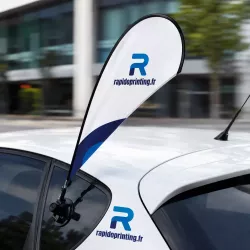
A magnetic fixing suits a clean, flat, metal bodywork, with quick fitting and removal. It is the right choice for a temporary campaign, a commercial fleet or mobile signage on a promotional vehicle.
Hold depends mainly on two points: the weight of the magnetic base and the actual contact surface. A format of around 80 x 100 cm remains visible at medium distance without creating excessive wind resistance, which avoids needless vibration in slow traffic or during frequent stops.
For the sail, UV-treated polyester remains the standard material for repeated outdoor use. With regular maintenance and outside extreme conditions, you can expect several seasons of use if the stitching and tension points are reinforced.
Is a suction cup reliable on glass or smooth surfaces?
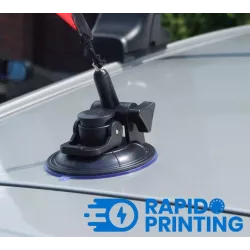
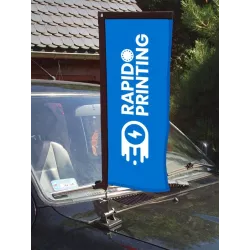
Suction cup fixing works on clean glazing, smooth surfaces or perfectly flat panels. It avoids any dependence on ferromagnetic metal, which makes it useful for certain shop windows, vehicle windows or temporary smooth supports.
Its weak point is well known: reliability drops as soon as the surface has dust, moisture or micro-irregularities. For this reason, it is reserved for use when parked, in a shop window or on a fixed support, not for sustained driving with a large format exposed to the wind.
When should you choose a backpack beach flag?
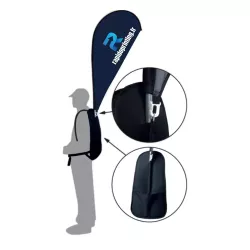
A format of 50 x 80 cm remains the best-balanced benchmark for carrying by a person; beyond that, comfort drops quickly and the visual stability becomes uneven. The backpack beach flag suits street marketing, welcome teams, flyer distribution and promotions across several sites in the same day.
The deciding criterion is not the height of the pole, but how the load is distributed across the shoulder straps and waist belt. If the system moves too much while walking, the flag goes off-axis, the carrier tires faster and the presentation looks less tidy after two or three hours.
In practice, rotating team members is preferable beyond 4 to 6 hours of continuous use. It is an effective display when mobility matters more than display area.
Does a bicycle beach flag have a specific use?
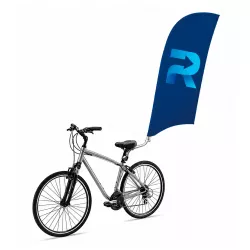
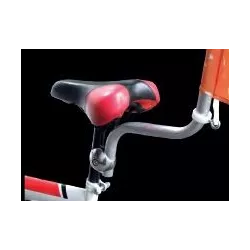
On a bicycle, the format must stay compact, with 40 x 60 cm being a sensible base to limit side wind resistance. Fixing is generally to a tubular frame, with a mounting that does not interfere with pedalling or short manoeuvres.
This type of mobile beach flag works well for local urban operations, neighbourhood campaigns and events in town centres or tourist areas. It is not designed for fast journeys or intensive use on exposed roads.
The non-negotiable point is safety: the fixing must remain stable without dangerously stiffening the whole assembly in the event of a fall or impact. If this criterion is not met, this method of carrying should be ruled out.
Is a table beach flag enough to mark out a space?
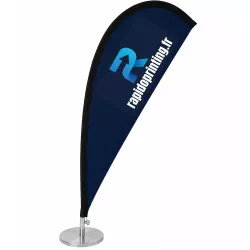
A table beach flag is not fixed to a vehicle or a carrier; it stands on a weighted base. It is the right format for a counter, a terrace, a reception desk, a secondary stand or an area to be marked out without a heavy structure.
Stability depends directly on the weight of the base. Outdoors, a light base tips over quickly: for moderate gusts, we generally recommend a base of at least 8 to 10 kg depending on the size of the sail.
Double-sided formats are useful when people pass in two directions. The stand stays the same, but the message remains legible whatever the angle of approach.
Which criteria matter most when choosing a mobile beach flag?
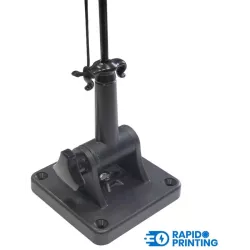
The first criterion is the mode of travel. Metal vehicle: magnetic. Glazing or smooth surface: suction cup. Carried by a person: backpack. Bicycle: dedicated tubular fixing. Compact fixed point: table base.
The second criterion is the balance between format and stability. For cars, stick to dimensions that are visible without overloading the aerodynamics; for carrying by a person, reduce the surface to preserve comfort; and for tables, size the base first, then the sail.
The third criterion is the real length of exposure. A campaign lasting a few days can use a lighter structure, whereas repeated use over several seasons calls for reinforced stitching, a UV-treated sail and fixing parts that withstand successive assemblies.
Which printing and finishing for a custom beach flag?
On a custom beach flag, the textile matters as much as the print. Polyester is chosen for its light weight, good wind resistance and compatibility with sharp printing on bold colours.
A matt finish limits glare under strong lighting or in a shop window, which improves the legibility of light flat tints. Double-sided printing is relevant when the display rotates or when the public approaches from two different directions.
The finishes that really extend service life are well known: reinforced stitching, topstitching on tension zones and a properly made pole sleeve. These details prevent tearing after repeated handling, not just the quality of the artwork file.
What lead times should you allow before a field operation?
For a standard format with simple printing and finishing, a lead time of around 5 working days remains a common basis. As soon as you add a specific mounting, double-sided printing or late artwork approval, allow more margin.
With this type of display, the classic risk is approving the artwork too late when the campaign depends on a fixed date. If the operation is tied to a trade show, a shop opening or a local tour, it is better to finalise the file several days before dispatch.
Mobile beach flag FAQ
Which format should you choose for a mobile beach flag on a car?
A format of around 80 x 100 cm offers a good compromise between visibility and stability. Beyond that, wind resistance increases quickly. For mobile use, legibility must not come at the expense of the fixing.
Is a suction cup suitable for long drives?
The suction cup remains suitable for smooth, clean surfaces, especially when parked or for temporary placement. Moisture, dust and vibration reduce its reliability. For repeated road use, a dedicated vehicle fixing is safer.
How long can a backpack beach flag be carried?
A range of 4 to 6 hours is bearable with a well-balanced model. Beyond that, comfort drops noticeably. Rotating between several carriers keeps the presentation tidier throughout the day.
Which finish really extends service life?
Reinforced stitching and topstitching on the edges are the most useful finishes. These tension zones wear out first. A decent sail without reinforcement tires faster than a well-finished one.