Advertising banners and promotional banners: choosing the right display for your exhibition stand or event
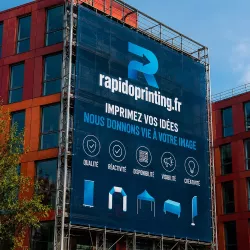
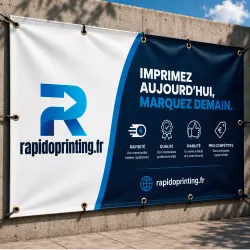
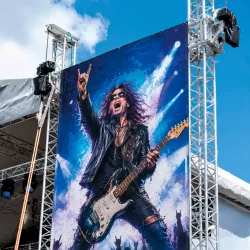
Between an advertising banner in 440 g/m² PVC and a micro-perforated mesh version, the difference is not only felt to the touch: it changes wind resistance, the tension of the display and its service life outdoors. The advertising banner and the promotional banner both belong to large-format signage, but they do not suit the same installation context. One is designed for longer-lasting installation on a façade, hoarding or fixed structure, while the other is better suited to an exhibition stand, a commercial campaign or a temporary event.
Which material really lasts, depending on how long it will be displayed?
PVC banner material remains the standard for prolonged outdoor use: it withstands UV, humidity and temperature variations better. For a short campaign, a coated polyester may be enough, with a lower weight and easier handling. Fabric is mainly reserved for indoor use or premium environments, where a glare-free finish matters more than weather resistance.
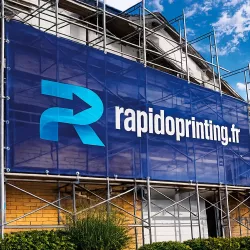
The material also determines the available finishes and the stability of the visual once installed. A display that is too flexible in large format shows marks more quickly at tension points. On a façade or scaffolding, we therefore recommend a material able to withstand steady tension without deforming after a few weeks.
Is a promotional banner the right choice for an exhibition stand or one-off use?
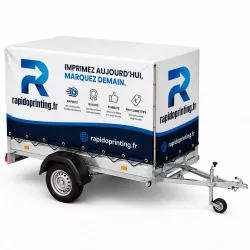
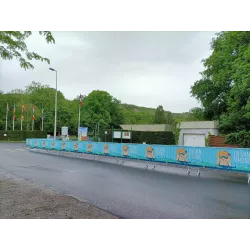
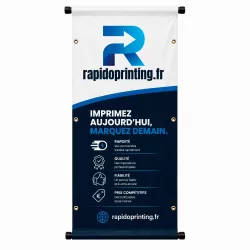
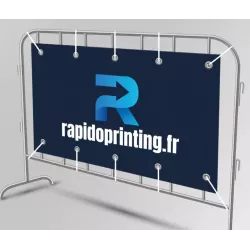
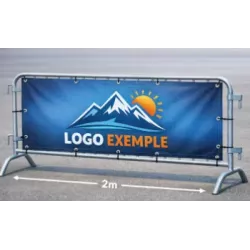
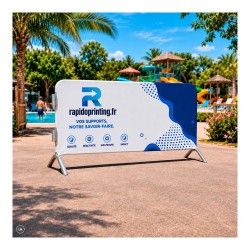
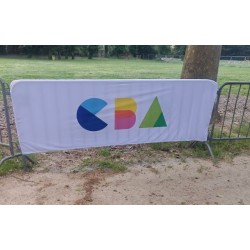
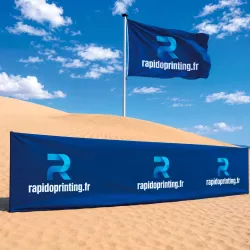
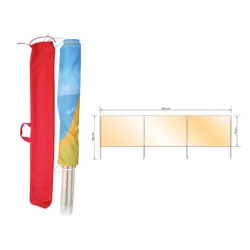
The promotional banner is well suited to short events, seasonal campaigns and exhibition stand operations. It attaches quickly to a barrier, a partition, posts or a lightweight structure, without requiring a permanent installation. It is the right choice when the display has to be put up, taken down, rolled up and reused across several dates.
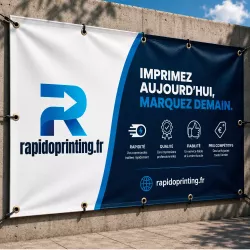
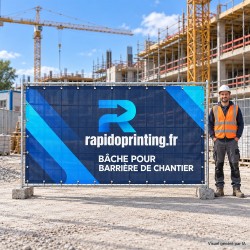
Conversely, a tensioned banner is better considered when the display surface stays in place for longer. It works with more constant tension and a more structured fixing system. For a point of sale, a façade or a construction site hoarding, this installation approach is often more reliable than a lightweight banner.
Mesh is the priority as soon as wind becomes a real factor
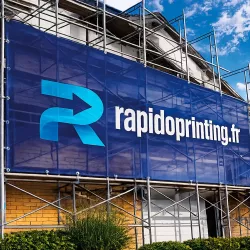
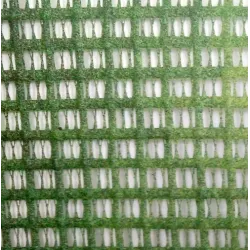
A micro-perforated mesh banner is essential in a windy area, on open fencing or on scaffolding. The perforations reduce wind load and limit the strain on the metal eyelets and anchor points. On large dimensions, this is often the criterion that prevents premature tearing, more so than weight alone.
In return, mesh diffuses light slightly more and loses a little visual density compared with solid PVC. For very close-up reading or a print with many dark solid areas, this matters. For long-distance outdoor visibility, the mechanical benefit generally outweighs it.
Which print result suits your viewing distance and lighting?
Large-format printing should first be judged by the actual reading distance. A message seen from 15 or 20 metres must rely on little information, sharp contrasts and a clear visual hierarchy, well before the question of resolution. On a stand or a trade-show aisle, a more generous width and a less cluttered visual often do more for legibility than a high print density.
The material also changes the result under lighting. Solid PVC can produce reflections under direct spotlights, whereas fabric absorbs light better. For a refined indoor environment, this visual behaviour matters as much as the print quality itself.
Which finishes prevent tearing and installation errors?
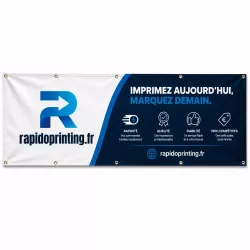
The metal eyelets, hems and fixing pockets are not there to tick off options: they determine how well the display holds up over time. For a made-to-measure banner intended to last, we recommend reinforced hems with eyelets suited to the installation method. If the pull is strong or repeated, reinforcing the corners becomes a real safety point.
Pockets are better suited to sleeves, frames or weighting bars than to direct tension on tensioners. Stainless steel eyelets are more appropriate for prolonged outdoor use than lighter finishes. A poor choice of finish often wears out the banner before the print itself shows any signs of fatigue.
How much lead time should you allow for a reinforced banner?
A simple finish with hem and eyelets is produced faster than a display with specific reinforcements, sewn pockets or stitched corners. As soon as stitching or more technical fabrication is added, you should generally allow a few extra days of production. This lead time mainly avoids an undersized order for use exposed throughout the season.
Is a fire-retardant standard mandatory for your installation?
A fire-retardant M1 advertising banner, or one rated under the standards in force for communication materials, is often required in enclosed trade shows, indoor exhibitions or certain public venues. This cannot be sorted out after printing: compliance depends on the material used from the moment of manufacture. If your organiser requires a certificate, it must be checked before the order is confirmed.
For a made-to-measure banner or promotional banner for a specific exhibition stand, the most useful step is to confirm the dimensions, the type of fixing and the display duration before launching production. Contact our team if you need to choose between solid PVC, mesh, fabric or reinforced finishes.