


Stand Partition
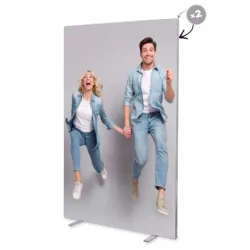
Showing 1-4 of 4 item(s)
A lightweight stand partition without a counterweight will not hold up against the drafts of a trade show hall, so the stability of the system is the criterion that matters most, well before aesthetic finishes. Between a partition anchored to the floor and a simple movable panel, the difference in reliability can mean a collapsed display in the middle of a presentation or hours spent reinstalling it. Event partitions should therefore be chosen first for structural stability, then for ease of use.
Stand partition: what level of stability do you really need?
A modular partition is not necessarily unstable. A well-designed aluminium structure supports a printed graphic without tipping over at the first passing crowd or on an uneven floor. This is the starting point for use at trade shows, in shopping malls or in temporary reception areas.
The format also affects how well the whole unit holds. A space 1.20 m wide does not call for the same configuration as a 6 m stand in a central aisle. To structure a space visually without making it feel heavy, a height of 160 to 200 cm is often chosen, enough to define an area without blocking circulation or overshadowing neighbouring stands.
Should you choose a mobile, weighted or floor-anchored partition?
The choice depends first on how often it will be handled. A partition with castors makes sense if you need to move the modules several times a day, for example to reconfigure a reception point, a demonstration area or a retail corner. You then need to check the quality of the castors and the locking mechanism, otherwise mobility becomes a source of instability.
For a stand set up once at the start of an event, a weighted base or a discreet anchoring system is safer. This type of installation limits unwanted movement and holds better in busy walkways. It is generally the right option as soon as the partition carries a large graphic or several accessories.
Which partition should you choose to divide a space without a permanent installation?
Modular partitioning is used to define areas without fixing them in place. You can separate a sales area, a reception, a light storage zone or a maintenance area without any building work and without losing light. It is a useful solution when the layout changes according to commercial campaigns or the events calendar.
A removable partition does not replace a wall; it serves a different purpose. It lets you reconfigure a floor area quickly, free up the space after a trade show and store the whole set without taking up much room. For temporary needs, reversibility is the deciding factor.
Tensioned fabric or rigid banner: which print medium suits your event partition?
Between a graphic on tensioned fabric and a covering on rigid banner material, the finish and the use are not the same. Tensioned fabric suits indoor environments better, where you want a sharp result without marked reflections under artificial lighting. Rigid banner material holds up well in more utilitarian settings, with simple handling and direct replacement of the graphic.
A customisable partition then becomes a communication medium as much as a dividing element. You can incorporate your brand guidelines, directional signage, or even functional options such as light shelves or display zones. You simply need to plan for the added load: the more accessories you add, the more stable the base must be.
Does reuse really change the cost of a modular partition?
A reusable modular partition above all reduces the need to replace equipment completely. If you attend several trade shows a year, keeping the same structure and changing only the printed graphic is generally more sensible than buying a new set for each event. It is also easier to manage for transport and storage.
This approach suits marketing teams, retail networks, associations and public bodies that set up temporary spaces on a regular schedule. The right indicator is not just the purchase price, but the number of installations the system can withstand without play in the structure, without deformation of the profiles and without loss of tension in the graphic.
Which criteria should you check before ordering a stand partition?
- Base stability: this is the first point to check for use at a trade show or in a walkway.
- Type of mobility: castors for frequent rearrangements, a fixed base for better hold in place.
- Suitable format: width and height must match the actual space, not just the desired graphic.
- Print medium: tensioned fabric to limit reflections, rigid banner material for a more direct and robust solution.
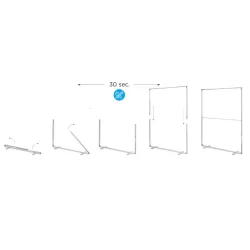
- Assembly time: a tool-free system saves real time on short installations.
- Graphic replacement: easy swapping extends the life of the structure over several events.
To structure a trade show stand, define a point of sale or fit out a temporary exhibition space, the right modular partition is the one that stays in place without supervision and can be reconfigured without wasting time. If the context calls for repeated installations, it is better to favour a structure that is simple to handle over an attractive finish that is fragile in use.