


Pavement Sign




Showing 1-5 of 5 item(s)
A pavement sign in anodised aluminium that is 75 cm wide disappears visually behind a neighbouring 100 cm panel at a trade show or outdoor event. Size is not an aesthetic detail: it is a question of legibility at 10 metres and of how visible you are to passers-by. Between an A-board designed for frequent moves and a fixed support for a permanent shopfront installation, the deciding criterion is your need for mobility and your display context: a few hours during a promotion, a commercial season, or a presence all year round.
Which material should you choose for an outdoor pavement sign?
Anodised aluminium is the best choice for an outdoor pavement sign used over the long term: it withstands freeze-thaw cycles, UV and rain. Thick plastic suits temporary or semi-covered use. Varnished wood exists, but needs regular maintenance in a damp climate.
The difference in lifespan between materials is tangible: an aluminium support generally lasts 3 to 5 seasons of direct exposure, compared with 1 to 2 for standard plastic. For a 3-week campaign or a weekend event, plastic is enough. For a permanent retail location, aluminium remains the consistent choice.
The stability of a pavement sign comes first outdoors
A pavement sign blown over by the wind is not just unsightly: it is a hazard in a pedestrian area. Stability depends on the built-in ballast, the width of the base and the weight of the support. It is the first point to check before the artwork or the finish.
Spring-mounted models absorb light gusts better than a rigid frame set too high. A stable pavement sign often weighs between 8 and 12 kg in the standard 75 × 110 cm format. Above all, check that the weight is distributed low and wide, not concentrated in the upper part.
Which pavement sign panel size suits your location?
The 50 × 75 cm format suits a shop entrance or a narrow passage. At a trade show, in a shopping arcade or in a lobby, moving up to 75 × 110 cm clearly improves visual impact. The 100 × 140 cm becomes relevant if you have room to stand back and a wide flow of pedestrians.
For a permanent shopfront, 75 × 110 cm remains a common baseline, as it offers a good compromise between visibility and wind resistance. Beyond 120 cm in width, you need to plan for an anchoring system or a reinforced structure. A large-format sign that is poorly stabilised ages badly and deforms faster.
Is a double-sided design useful on an advertising A-board?
A double-sided pavement sign panel catches pedestrians approaching from two opposite directions. On a shopping street, it is often the most logical format, since a single face wastes half the foot traffic. The benefit is not decorative; it comes down to the actual direction of the flow.
Four-colour printing is worthwhile if your message stays legible from more than 5 metres. Text that is too fine, a light grey background or an overly busy photo fades as soon as the support is placed on the pavement. Before printing, test the layout from a distance, not only on screen.
Should you choose a mobile pavement sign or a fixed support?
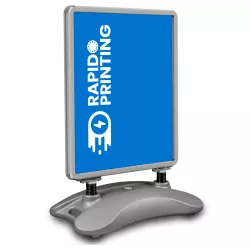
An A-board on castors suits you if you take it out and bring it in every day, or if you often change its position according to customer flow. A fixed splayed base is better suited to a lasting façade installation. Castors save time, but add weight and a little mechanical complexity to keep an eye on.
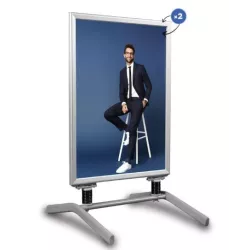
A removable poster holder system is useful if your message changes every week. The clip-in frame avoids handling the whole support to replace the poster. It is a real advantage for recurring promotions, menus or seasonal campaigns.
Which pavement sign for a short-term promotion?
For a campaign of 2 to 4 weeks, a mobile plastic pavement sign or a lightweight advertising A-board is enough. The right choice depends mainly on the size of the message and the placement point. If the support is positioned too far from the entrance or is undersized, it becomes secondary in the pedestrian journey.
Commercial promotions, sales or product launches call for a support that is easy to move during the day. You can then adjust it according to the direction of foot traffic or the level of footfall observed. In this context, mobility matters more than a lifespan covering several seasons.
Which support should you choose for a permanent shopfront presence?
A permanent outdoor pavement sign must withstand 12 months of weather without looking quickly worn. Aluminium and a replaceable display system limit maintenance. A clip-in frame or a poster holder protects the image of the point of sale better than a basic support that quickly shows wear.
A double-sided advertising panel placed at the corner of a shopping street can reach several hundred pedestrians a day. Conversely, a tarnished, warped or faded structure immediately conveys a neglected image. For permanent use, visual durability matters as much as legibility.
Which pavement sign variant matches your use?
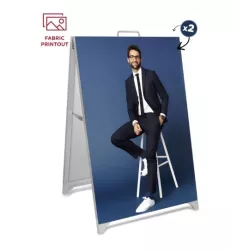
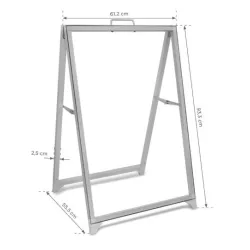
- Pavement sign (A-board): compact format, simple mobility, suited to shops and one-off events. Available in plastic or aluminium, with moderate ballast.
- Chalkboard pavement sign: wooden or aluminium frame, erasable chalkboard or white surface. Suited to indoor use, semi-covered areas and short messages that change often.
- Outdoor advertising A-board: anodised aluminium, reinforced stability, double-sided. Relevant for the street, terraces, car parks and semi-permanent to permanent use.
- Custom pavement sign panel: direct printing on aluminium or rigid PVC. Suited if you keep the same artwork for a long time and want to avoid replacing posters.
- Large-format advertising pavement A-board: wide base, castors optional, stronger visual presence. Best reserved for spaces with enough room to stand back and where wind exposure is under control.
Each variant answers a specific context: the mobile A-board for flexibility, the chalkboard for quick changes, the rigid pavement sign support for a more durable image. If your goal is rotating offers, the poster-change system comes first. If you are looking for a stable presence on your façade, the material and the base take priority over the rest.