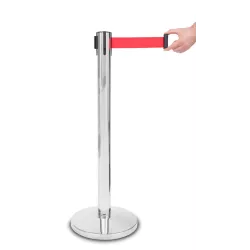
The belt barrier: stability is the decisive factor in crowd flow management
A belt barrier that tips over under the pressure of visitors provides neither safety nor credibility. The stability of the base, whether a weighted plate or a wall mount, matters more than any other criterion. It determines whether your zone delimitation holds up all day or shifts at the first knock.
The belt barrier is used to organise queues, guide visitors and channel flows in public spaces, reception halls or event environments. For occasional use, a mobile post is often enough. For repeated traffic in a walkway area, the stability of the base or the wall fixing becomes the real selection criterion.
Retractable belt: which length should you choose for your area?
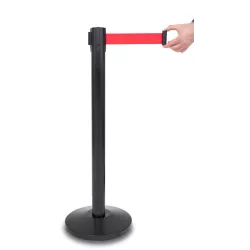
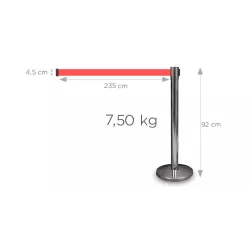
A retractable belt of 2 to 3 metres covers a standard passage, an aisle or a short queue. Beyond that, belt tension and the strength of the anchor point must be checked to prevent sagging in the middle of the passage. The belt length should therefore not be chosen solely according to reach, but also according to how clearly the separation reads and how often it is used.
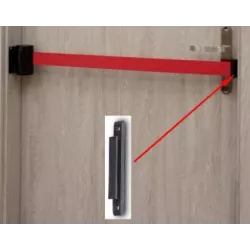
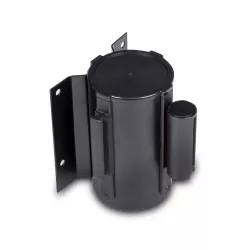
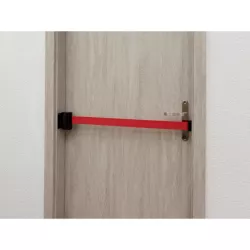
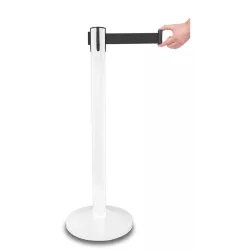
A guide post with an integrated retractor suits situations where the layout changes regularly throughout the day. The wall mount takes over in corridors, checkpoints or technical access areas where every centimetre of floor space counts. In that case, you save space and avoid bases protruding into the traffic path.
Removable post or wall mount: the right choice does not depend on the finish
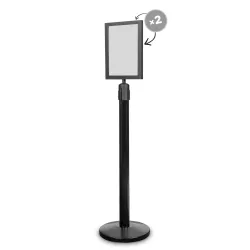
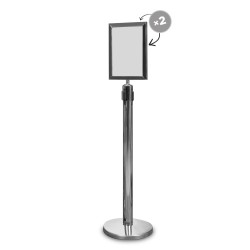
Models on a weighted plate are suited to temporary installations, trade shows, short-term reception areas or variable queues. They can be moved quickly, but they need a sufficiently heavy base if traffic is dense. In a permanent space, the wall-mounted version is tidier in use and harder to move by accident.
Stainless steel withstands intensive use and repeated handling better than finishes that are more prone to scratching. Aluminium lightens the whole set-up, which is useful if the posts need to be moved often. Painted steel is suitable indoors when the main aim is visual consistency with existing furniture or signage.
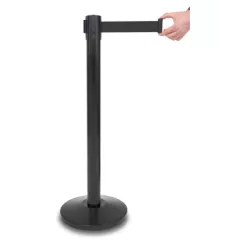
Finishes such as chrome, black, lacquered or red mainly affect how the space reads. A black post blends into a understated reception area, while a red one makes the separation immediately visible in a high-traffic zone. This is not a decorative detail: colour influences how a prohibition or the path to follow is perceived.
Queue, restricted access, technical area: the same barrier does not meet the same need
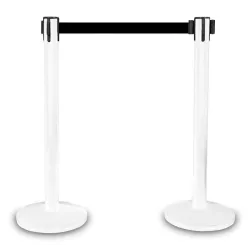
For a queue, the priority is smooth movement along the route. You need a clearly visible belt, a simple connection between several posts and a layout that is easy to change according to footfall. In this context, mobile posts are the most practical.
For a restricted access area, the separation must be understood instantly. A contrasting belt, a stable anchor point and a short layout limit attempts to bypass it. The aim is less to organise a flow than to mark a limit clearly.
In a workshop, warehouse or logistics area, the safety barrier is mainly used to delimit a temporary or semi-permanent perimeter. Impact resistance, belt visibility and the strength of the fixings take precedence over appearance. In these environments, a system that is simple to set up again is better than an elegant but overly light model.